The Supermarket That Was Never Built
New York City says its new municipal supermarkets will sell a basket of essential groceries for 30% less than private stores. The discount covers produce, meat, seafood, dairy and pantry staples, regardless of a shopper’s income. City Hall estimates the program could cut a participating household’s total grocery bill by about 15 percent, roughly $1,000 a year.
If the city can sell for $70 what an ordinary supermarket sells for $100, where is the other $30 going? It’s not going to supermarket owners.
Food retail is among the lowest-margin major industries in America. The average net profit margin for food retailers was between 1-3% in 2026. On a $100 grocery bill, the store keeps about $2 after paying for the inventory, workers, refrigeration, rent, spoilage and everything else.
Eliminate the profit entirely and the $100 basket might cost $98. It does not cost $70. The remaining discount must come from somewhere else.
Under Mamdani’s model, the city will own the properties, pay for construction and absorb overhead that private stores have to recover from customers. Private operators will run the stores, but the government will set the mission, labor standards and prices. The city has already allocated $70 million in capital funding to build five locations, one in each borough.
This doesn’t make groceries 30% cheaper to produce or distribute. It moves part of the cost away from the checkout counter and to the taxpayer.
Affordability by subtraction
Mamdani’s proposal belongs to a broader style of politics that treats high prices as arbitrary numbers imposed by insufficiently compassionate businesses. Housing is expensive, so limit the rent. Childcare is expensive, so cap the price. Groceries are expensive, so open a government store and require it to charge less.
The political attraction is obvious. The benefit appears immediately and is simple to understand. A mayor can hold up a banana with a 30 percent discount sticker. The costs are scattered across budgets, taxpayers and future years.
Tyler Cowen’s warning about affordability politics is that governments are tempted to wage war on prices instead of the conditions that produce them. The sustainable path to affordability is slow and unglamorous: greater supply, cheaper energy, easier construction, more competition. Those reforms rarely deliver a dramatic price cut before the next election. That creates an opening for politicians willing to promise something more visible even if long term it makes the issue worse. The government chooses the price people would like to pay, then conceals, transfers or postpones the difference.
A supermarket without supermarket costs
Supporters describe the city stores as a public competitor that will prove groceries can be sold more cheaply. But a competitor normally competes in a free market. A private grocer must acquire a location, finance construction and equipment, maintain the property and survive a bad year. Calling the resulting price a triumph of public efficiency confuses a subsidy with a productivity gain.
Suppose the city gave one restaurant a free building, paid for its kitchen and required it to sell dinner for half the price charged next door. The restaurant would be popular. Its popularity would tell us very little about whether it used labor, food or capital more efficiently. It would tell us that people prefer paying less when someone else absorbs part of the expense.
The city may find some legitimate efficiencies: favorable wholesale contracts, a private label, a simpler assortment. Those should be tested. But the arithmetic sets a limit on how much efficiency can explain. When the entire industry earns about two cents on the dollar, a 30 percent discount cannot principally come from eliminating profiteering. It must come from free capital, forgone public revenue, an operating subsidy, lower quality, rationing or some combination of them.
Even the city’s own defense now refers to a “financially sustainable operating subsidy.” They know this isn’t possible without consistent subsidies. A subsidy may be politically sustainable but it’s not evidence that food has become cheaper to provide.
Why the first stores may appear to work
The first five stores may be pleasant, well-stocked and extremely popular. That would not vindicate the model. A taxpayer-backed store can succeed as a store while failing as affordability policy. Long lines would demonstrate strong demand for discounted food. We already know that demand exists.
The harder questions: How much did each dollar of customer savings cost the public? Who received the subsidy? What happened to nearby stores? Could the program expand without a growing claim on the city budget? What went unfunded because money was committed here?
A discount available to everyone directs public resources toward whoever can reach one of five locations. A middle-class professional who lives nearby receives the same discount as a family struggling with food insecurity. A poor resident far from a municipal store may receive nothing. If the objective is to prevent hunger, direct assistance is likely to reach the intended population more precisely. Food benefits, produce incentives, tax credits and cash transfers let low-income households shop across thousands of stores instead of five. Targeted assistance is much less photogenic than a new store opening.
The danger to competition
The deeper problem emerges when municipal stores compete with businesses that must bear their own costs. Private grocers cannot answer a 30 percent discount by surrendering their profits. There are only about two percentage points of profit to surrender. To match the price, they would have to cut wages, delay investment, carry fewer products, accept losses or close. Independent supermarkets and neighborhood stores are the most vulnerable.
The damage is not limited to the discounted staples. Milk, eggs, meat and produce are the reasons customers walk in. The same trip sells the higher-margin goods that keep a grocer solvent. When the government store underprices the products that generate visits, it drains traffic from everything else.
Five locations will not transform a market of more than a thousand grocery stores and thousands of bodegas. But a program sold as a citywide affordability solution cannot be judged at pilot size. If five stores remain five stores, they help a small number of people and change nothing citywide. If they are popular enough to matter, they must expand. And if they expand while retaining public real estate, construction funding and mandated below-market prices, they will compete against private stores on terms private stores cannot reproduce.
The cycle is predictable. The city subsidizes a store. Customers follow the lower price. Nearby stores lose volume, postpone investment or close. Potential entrants hesitate to risk capital where the government may build a subsidized competitor next door. The decline in private options is then cited as further evidence of market failure and a reason to expand the public system.
Rent control shares the structure through a different mechanism. It provides a real benefit to visible incumbents, paid for by investment that never happens. Research on San Francisco found that affected landlords reduced rental supply by 15 percent, ultimately pushing rents up elsewhere in the city.
A strange definition of market failure
Mamdani has argued that corporate control of the food supply chain has made basic necessities unaffordable and that a public option is required because the market has failed. The industry’s margins make that diagnosis difficult to understand. Market power can exist elsewhere in the food system, in agriculture, processing or particular neighborhoods. But the retail supermarket does not appear to be sitting on a hidden reservoir of excess profit large enough to fund dramatic price cuts.
Grocery prices reflect an extended chain of farms, processors, warehouses, truckers, property, energy and labor. A municipal store enters near the end of that chain, buying food shaped by the same upstream costs as everyone else. It cannot fix a cattle shortage, make refrigerated transport free or cause crops to grow more cheaply. It can only decide how much of the final cost the shopper will see, and how much the taxpayer must subsidize.
Food access is a different question
There are cases where a public or nonprofit grocery store is justified. A rural town may lose its only supermarket. A poor urban neighborhood may lack access to fresh food. Government may decide that access has social value beyond what a store can recover through sales. That is comparable to subsidizing a rural bus route, clinic or post office.
New York City already has a program built around that narrower problem. FRESH provides zoning and tax incentives for private supermarkets in underserved neighborhoods. At least 53 stores have opened or entered development through it since 2009. A municipal store in a genuine food desert can be defended as targeted infrastructure.
Mamdani’s claim goes much further. The stores are promoted not as a last resort where private supply is absent, but as a model for lowering grocery prices generally. The discount applies regardless of income and is promised across all five boroughs.
The bill does not end at the city line
In May 2026, Albany announced nearly $8 billion in state assistance and gap-closing support for New York City over two years, including an additional $4 billion to close the city’s budget deficit. The city then added $70 million to its capital plan for grocery stores.
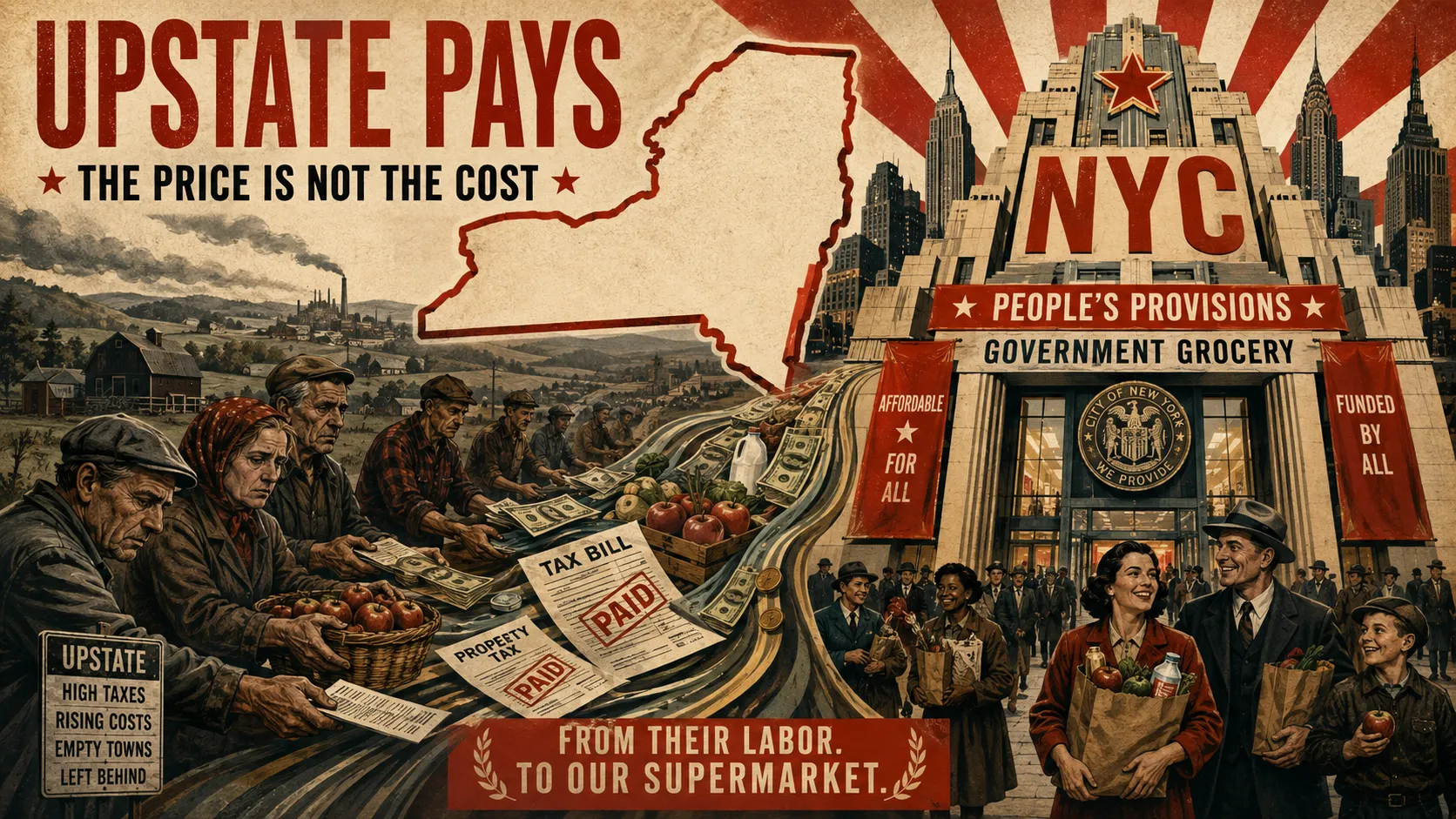
The state money is not earmarked for supermarkets, and the city generates a large share of state revenue. But budgets are fungible. When Albany closes the city’s gaps, it preserves the city’s capacity to fund experiments, while the grocery discount stops at the city line. An Upstate family facing the same food inflation will keep shopping at a private supermarket that pays its own rent, taxes and construction costs, and it receives no access to the discounted basket.
Whatever one concludes about the broader upstate/downstate fiscal ledger, taxpayers deserve an honest accounting of that tradeoff. Why is the state filling city budget deficits if this is how they spend? As an upstate New Yorker, I find this extremely unfair.
What durable affordability would require
There are no painless ways to reverse a large increase in grocery prices. Food becomes sustainably more affordable when farms grow more productive, energy and transportation get cheaper, supply chains improve, stores are easier to open, and household incomes rise faster than food prices.
New York City can contribute at the margin: faster permitting, modernized zoning, better loading and delivery access, less theft, expanded targeted food assistance and an examination of whether its own taxes, labor rules and land-use restrictions make grocery retail unnecessarily expensive. None of it has the satisfying simplicity of a 30 percent sticker. All of it is more likely to improve affordability without destroying the conditions that make future supply possible.
The missing $30
A municipal supermarket can charge whatever price the government chooses, at least for a time. That power should not be confused with an ability to make goods cost less. If a $100 basket sells for $70, the missing $30 has not vanished. Someone supplied the land. Someone built the store. Someone absorbed the risk. Someone covered the loss.
Mamdani’s policy places the discount in the most visible location and the cost in the least visible ones. That may be good politics but it’s horrible economics.
The danger is that an apparent early success will validate a much larger mistake: the belief that affordability can be created by insulating favored providers from costs and ordering them to display a lower number. Over time, that is a formula for fewer independent stores, more political allocation and a public obligation that grows harder to reverse as private alternatives weaken.
A society becomes more affordable by producing more, building more and competing more effectively. There are no shortcuts.