Algorand, A Very American Coin
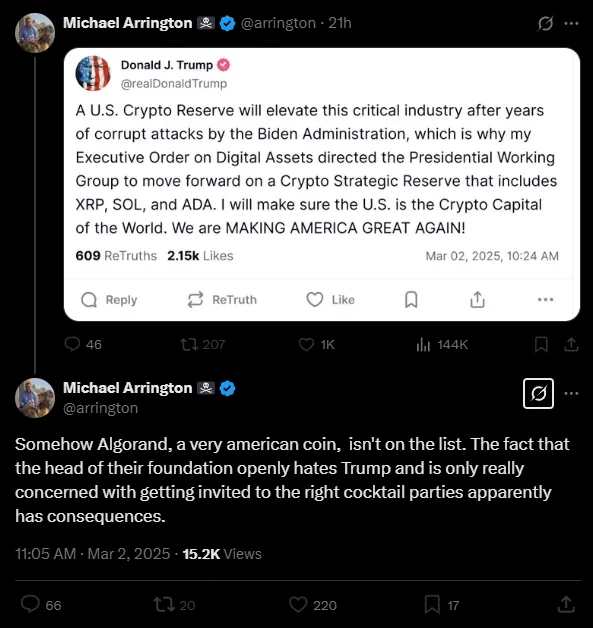
Trump announced a US Crypto Strategic Reserve that specifically mentioned XRP, SOL, and ADA. Michael Arrington couldn’t wait to take a shot at Algorand, claiming it was left out because “the head of their foundation openly hates Trump and is only really concerned with getting invited to the right cocktail parties”.
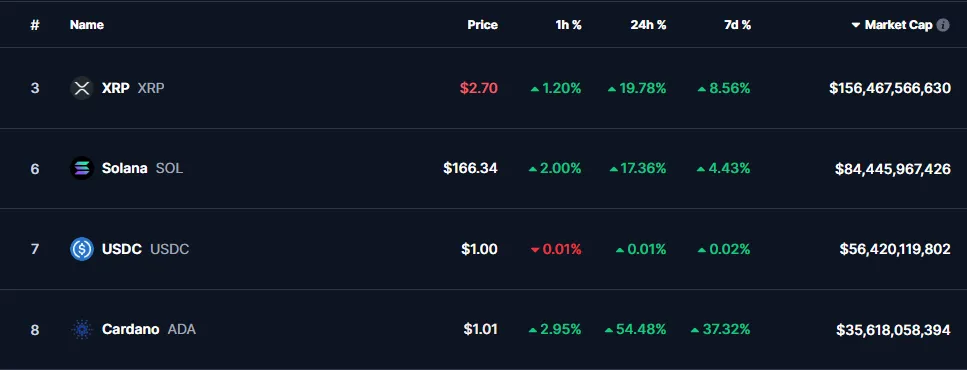
The announcement clearly focused on the largest market cap coins. Algorand would likely be included in any comprehensive reserve, especially given it’s American-made. To his credit, Arrington acknowledges Algorand is ‘a very American coin’, but conveniently glosses over the obvious market cap explanation for why it wasn’t specifically named in the initial announcement.
But Arrington’s take reveals a more troubling mindset that’s increasingly common in crypto — the idea that sucking up to power for short-term pumps is somehow a victory for the industry. I would argue these people care little about the core beliefs of decentralization, censorship resistance, economic freedom, etc., or at least care far more about shareholder return and mansions in Miami.
What Actually Matters for Algorand
I believe a crypto reserve could be good for the industry if done right. But “done right” means:
- Creating policies that protect privacy rights and economic freedoms
- Ensuring regulatory clarity without regulatory capture
- Maintaining crypto’s global, borderless nature
- Building systems that can’t be co-opted by power-hungry authoritarians
Getting Algorand on some government shopping list might give us a short-term pump, but having Staci and the AF in the room when actual policy is crafted? That’s worth infinitely more IMO.
The Authoritarian Trap
We’ve seen this movie before. Authoritarian-leaning leaders embrace crypto when it serves their purposes and crush it when it doesn’t. They love using crypto to evade sanctions but hate when their citizens use it to escape their control. They love it when they can receive large donations to help get elected but hate when their opponents do the same.
They’ll praise decentralization and censorship-resistance when traditional financial institutions block their funding channels, but the moment crypto enables journalists to publish unflattering truths or helps organize opposition movements, suddenly they’re calling for “reasonable regulations” and “national security protections.”
Let’s not forget how quickly “crypto-friendly” regimes pivot to seizing assets when their power is threatened. Just look at how Russia’s stance evolved — from Putin signaling openness to Bitcoin in 2018 to Russian courts later ordering crypto seizures from political dissidents. Or how exchanges that refuse to impose politically-motivated freezes suddenly face regulatory crackdowns from the same politicians who once claimed to champion financial freedom.
Is that the company we want to keep?
What’s at Stake
The crypto movement wasn’t born so governments could pick winners and losers. It emerged from a desire to create systems resistant to exactly this kind of political meddling. A form of money separate from the state and the states influence.
The pump is beautiful, money is fantastic, trust me I understand. I rely on this industry to feed myself. But I certainly don’t bow to authoritarians for handouts, and if that’s what it took for crypto to be successful I wouldn’t be interested in the industry.
When we celebrate political favoritism just because it benefits our bags, we’re betraying the very principles that make this technology revolutionary. We’re saying we don’t actually care about decentralization, censorship-resistance, removing the state from the money supply — we just want our coins to pump. And if that means sucking up to whoever has political power at the moment, so be it.
But this approach is not just ethically questionable — it’s short-sighted. Political winds change. Today’s favorite is tomorrow’s target. Building systems that depend on government favoritism rather than technical excellence and genuine utility is building on sand, not bedrock.
True success in this space means creating value that stands on its own merits, not because some politician decided to include you on their list. It means focusing on solving real problems and expanding human freedom. We should be able to be target #1 from a government and pump in the face of it, because that’s how distributed and decentralized the network is, and how strong the core beliefs are amongst the node operators.
The Path Forward
Satoshi didn’t create Bitcoin with the intent of it becoming a reserve asset of the United States. Bitcoin earned its status by staying true to its core principles of censorship-resistance, decentralization, and fixed supply. It became valuable precisely because it stood against government control, not because it sought government approval. All those years of the establishment attacking Bitcoin just cemented the conviction of those who understood what this revolution was really about.
The new wave of crypto participants views this space more like a casino than a revolution — I doubt Satoshi would have envisioned gamblers & VCs becoming the dominant political crypto force. Now the government is primarily trusting people like David Sacks, whose entire business model revolves around shareholder returns, treating crypto just like any other speculative asset — AI, robotics, whatever has a buzzworthy “future use case.” These VC types aren’t buying in because they share our values; they’re here to make a return. These aren’t the people who should be crafting policy or designing the crypto reserve, but here we are.
Algorand needs to be in the room, not so we can get included in some government shopping list and watch the coin pump, but so we can be the voice for decentralization, censorship resistance, and all the other values that make crypto revolutionary. Being a counterbalance to those who just want to extract profit is crucial — that’s the most important role Algorand can play right now.
This piece originally appeared on Medium .