The Chicken and The ALGO
Crypto protocols rarely grow linearly, they move in reflexive waves. Developer and user inflows spike when token prices rise, and plateau (or reverse) when they fall. Price action is therefore not a vanity metric, it’s an acquisition engine for both users and builders and should be top of mind for any organization responsible for a crypto ecosystem. Price is the ultimate KPI.
The Algorand Foundation (AF) still holds ~1.4 B ALGO or about 14% of total supply. After a temporary pause in structured selling in mid 2023, the Foundation resumed regular selling and hasn’t slowed down.
In Q1 of 2025 we saw an egregious 174M ALGO sold. Q2 of 2025 is on pace to see ~80M ALGO in sales, which is more in line with the historic average of ~100m, but is still far too high for what we’re getting in return, or what’s sustainable.
With a circulating float of roughly ~8.6B ALGO, 100–200M per quarter may sound modest but it represents months of average spot bids. Liquidity-adjusted, these sells meaningfully impact the price and therefore hurt user and developer growth.
The net effect of this selling is a structural headwind. Every fundamental improvement must first clear the Foundation’s sell quota before it can translate into upward price discovery.
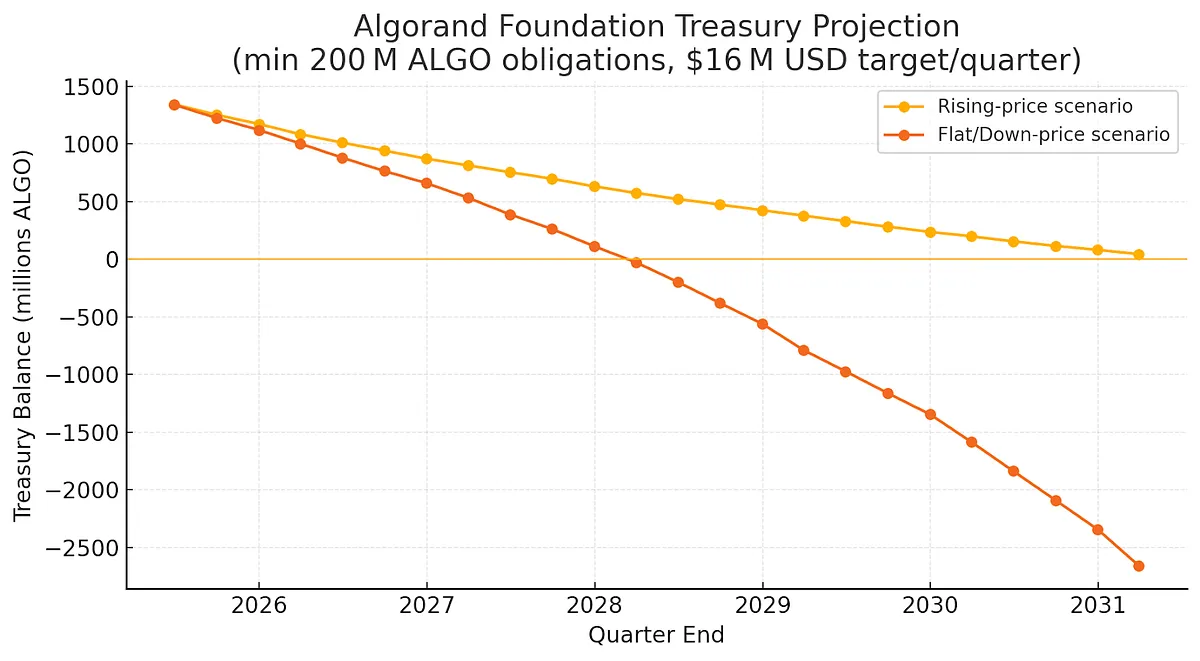
Here’s a rough projection of the remaining ALGO if outflows stay on a similar trajectory (best case scenario ~80M per quarter, without any outlier -200M ALGO quarters).
Assumptions
- Starting treasury: 1.434 B ALGO
- Minimum reserved distributions: 150M to node rewards + 50M to xGov → 200M ALGO total, paid out evenly over 16 quarters ( ~12.5M ALGO/q) (not exact, this is my best guess)
- USD ALGO sales target per quarter: $16 M (~ Q2 2025 80M ALGO sell at ~$0.20)
- Sale strategy: each quarter they adjust ALGO sold to hit the ~$16M target, then we add the 12.5M reserved distribution
- Random variance: ± 10% around the required sale (they’re never perfectly on target)
Two price paths
- Rising: ALGO price +5 % every quarter
- Flat/Down: ALGO price –5 % every quarter
You can see that again, price plays a significant role in sustainability. In one scenario all the ALGO is sold by Q1 2028, and another still has ALGO left in 2031. (This doesn’t account for AF’s USD balance which can only be estimated at ~$50M — 100M+)
AF’s stated justification for selling is “ecosystem growth,” yet:
- The grants program was wound down at the end of 2022.
- xGov has been not great up to this point. In Q4 2024 only 243K ALGO ($48K) reached builders via the xGov pilot. This is magnitudes smaller than what is being sold. I previously wrote about this misalignment.
The iteration cycles for xGov cannot take 1 yr+ while at the same time having no support system for developers. The very obvious result of this is a net outflow of talent.
- Foundation sells to fund ops → price goes down
- Lower price → fewer speculative users, shrinking TAM
- Smaller TAM & grant drought → builders leave or pivot because 0 opportunities for revenue
- Reduced on-chain activity → narrative stagnates, reinforcing step 1, and forcing AF to sell more to reach their USD target
Because demand reacts second while supply pressure is first, the loop is hard to break without attacking the supply side directly.
Narrative follows price, not the other way around.
Below is a non-exclusive and non-exhaustive list of approaches to consider moving forward. This is meant to spur discussion amongst the community and to hopefully display to the AF realistic ideas for moving forward. The asks must be in line with what they can do & what they’re willing to do.
1. Budget-Capped Foundation with Hard Guardrails
- Community-ratified cap on quarterly ALGO outflows (e.g., ≤ 50 M) that decays 10% annually. Both number and decay could be voted on values.
- Daily sell cap tied to on-chain volume (e.g., ≤ 1 % of prior-day DEX volume). AF’s current “-10% daily price limit” implicitly accepts nuking the price. Anything larger than 1% a day can still be damaging.
2. On-Chain-Only Sales + Liquidity Commit
- AF commits to sell exclusively through DEXs. No OTC or centralized exchanges.
- AF pairs $10M+ USDC and $10M+ worth of ALGO on Tinyman and Pact, and deposits into Folks Finance lending. (non-exhaustive list, diversify it out across all major defi platforms)
- Sales executed via TWAP bots that cannot exceed 1% of 24h on-chain volume.
Effects:
- Slower sales by design. Liquidity is thin on-chain, so the Foundation must dribble, not dump.
- Arbitrageurs back-fill CEX books, creating healthy two-way flows and volume on-chain.
- TVL jumps immediately, making on-chain swaps execute with less slippage, better for everyone.
- Transparency goes from quarterly PDFs to live chain data.
Risks: Exposes treasury to impermanent loss and contract risk.
3. Phased Treasury Hand-Off to xGov
- Time-lock ~100% of remaining ALGO into a contract that releases equal monthly tranches to xGov.
- Foundation staff transition into xGov-funded “steward roles” or “working groups” over ~18 months.
Effects: Aligns incentives, rushes decentralization of the org, and battle-tests xGov with real budgets.
Cons: xGov security/process must harden fast, will need to be gradual.
4. Wind-Down & Programmatic Emissions
- Split treasury into two contracts: validator rewards (10- 20 year schedule) and a fixed-cadence public-goods fund (distributed through xGov over 5–10 years).
- Similar to previous options, xGov funds working groups which are a mix of ex-AF employees and community members.
- Corporate entity dissolves or merges with Algorand Technologies; IP/repo stewardship migrates to Algorand Technologies or working groups under permissive licensing.
End
Algorand’s dilemma is not a mystery of the chicken and the egg, do we need users first or builders first?! This argument is frivolous in my view, and putting energy towards this can only paper over the fundamental issue. It is a supply-and-incentive mismatch: a very large seller funding comparatively little that directly grows token demand. Hopefully xGov will fix the funding issue, but we need more to assure structured selling doesn’t continue in such a destructive fashion.
History shows that when price goes up, developers and users follow. The fastest route to price going up is to stop fighting the market with your own treasury.
My worst case scenario is one where AF spends all the ALGO and then hands off to the community where there’s near zero chance of a recovery. We must act before it’s too late, and I think that time is getting closer.
Mandatory additional reading:
The end of the foundation era in crypto
Tokens are the new Herbalife. Parallelisms between crypto and MLM schemes
This piece originally appeared on Medium .