
Musings on the Pond II
Special thanks to those who encouraged me to publish this and those who helped with review and feedback — Govhat, Hampelman, Django, MJ and Doug
The Algorand ecosystem has made real progress since my last Musings, and I’m excited to share some updates. We’ve cut spending, reinforced the economic foundation, and built a stronger team. But challenges remain — network revenue is low, governance needs serious improvement, and the long-term economic model isn’t fully there yet.
This post will briefly cover:
- Spending cuts — how the Foundation nearly halved its outflows.
- Marketing — what’s working, and why it finally feels like we have a voice.
- Consensus rewards — why they’re a major upgrade but still need fine-tuning.
- Revenue sustainability — why base transaction fees alone might not be enough.
- Governance — why xGov in its current form is suboptimal.
- On-chain assets vs. RWAs — and why AF doesn’t need to pick sides.
- The road ahead — how regulation, positioning, and execution will determine our future.
Spending Cuts
The Algorand Foundation has significantly reduced its outflows over the past year.
- Q4 2023 net outflows: -$45.8M
- Q4 2024 net outflows: -$24.1M
Total reduction: -$21.7M (-47.4% YoY decrease)
ALGO-Denominated Expenses (Q4 24):
- Governance Rewards: 40.9M → 17.0M (-58.4%)
- Investments & Grants: 79.0M → 60.8M (-23%)
- Foundation Expenditures: 9.5M → 8.6M (-9.5%)
It’s evident that spending has been brought under control. It finally feels like operationally, Algorand is on the right path. This sort of spending is in line with other foundations (those with transparency reports), but still presents issues long-term, as the AF will run out of ALGO at some point, especially if the price remains low.
While decreasing spend, the quality of hires has improved dramatically. The additions of D13, Krby, Silentrhetoric, Loafpickle, Michael Chuang, MJ, SJ, Michael Feher, Diego, Marc, and Giulio — all individuals deeply rooted in the Algorand community — is a massive upgrade. This group has proven its dedication and talent over time. I personally feel incredibly bullish on the group of individuals currently at the foundation.
Marketing

Marketing has significantly improved under Marc. For the first time, Algorand has a real voice on Twitter — engaging, responsive, and in tune with the community. The marketing team isn’t just broadcasting, but listening, adapting, and amplifying the best ideas from the ecosystem. The recent commercials were high-quality and actually memorable.
The #FixTheData campaign has been a huge success — making sure Algorand’s capabilities aren’t just acknowledged within our bubble, but properly recognized beyond it. Essential work that isn’t getting nearly enough credit or attention.
Of course, marketing Algorand isn’t just the Foundation’s job — it’s on all of us. But having well-crafted, rally-worthy content makes it significantly easier to spread the message and drive impact. Hats off to the marketing team.
Consensus Rewards

The launch of consensus rewards is the single biggest upgrade to Algorand since genesis. It’s leading to an explosion of both stake and Validators, which is crucial for maintaining a strong and decentralized network. Exhibit 1:
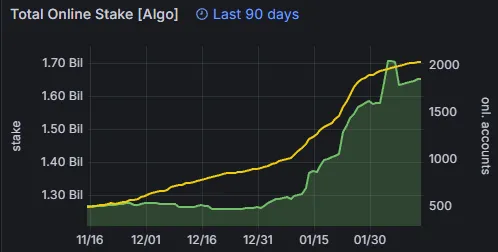
ALGO has transitioned from a purely speculative asset to one tied to real economic activity. This is important for investors — offering a yield backed by real usage and not just inflation. The economics still need refinement, but this puts ALGO in a stronger position than ever, and opens up new opportunities for users and builders.
Revenue Sustainability

Without Foundation subsidies, node rewards will be extremely low unless there’s unprecedented transaction and price growth within a few years. Even at 5x the current transaction levels (500 txns per block), rewards per block will drop from ~10 ALGO to just 0.5 ALGO.
Even in a good-case scenario, with 500 txns per block and where ALGO’s price surges 10x to $4, validators would earn just $2 per block — half of today’s earnings. This underscores a problem: transaction fees, as currently designed, are probably not enough to sustain the Validator network, even with good-case scenario projections on growth and price appreciation.
Simply saying, ‘we just need more txns and everything will be ok’, is only partially true. If we had 10k txns/block, that’s 10 ALGO per block in fees. If the accounts spamming txns are simply record keeping, or spam, there is no emergent value created or captured above and beyond the base transaction fee. We have seen increased usage over the past 5 years, yet the price of ALGO has fallen precipitously, proving the relationship between usage and price isn’t clear cut. They may be correlated, but most things are.
Why Raising the Base Fee Isn’t the Solution
Since my last Musings, I’ve become convinced that simply raising the base fee is not the optimal solution. Instead, here are a few other ideas:
Prioritization fees — These are optional fees that can be paid to Validators to boost a transactions position in a block. This opens Algorand up to potentially harmful MEV strategies, but also potentially good ones. I won’t get into too much detail here, but here’s a good primer on MEV.
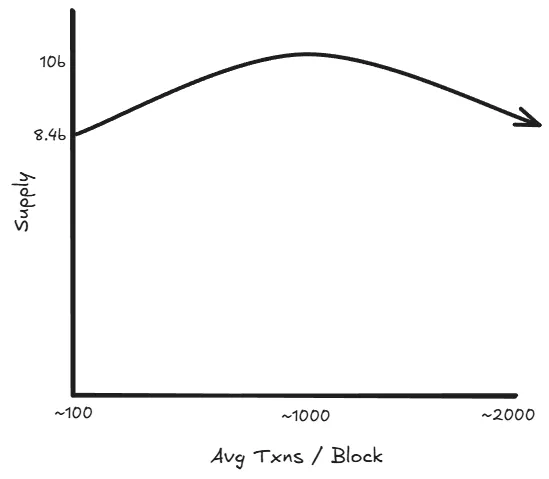
Inflation + Burn — This would uncap the fixed supply of ALGO by adding an inflation schedule, while also adding a token burn. The inflationary rewards would be paid to block proposers, on top of a portion of the txn fees, with the other portion of fees being burnt.
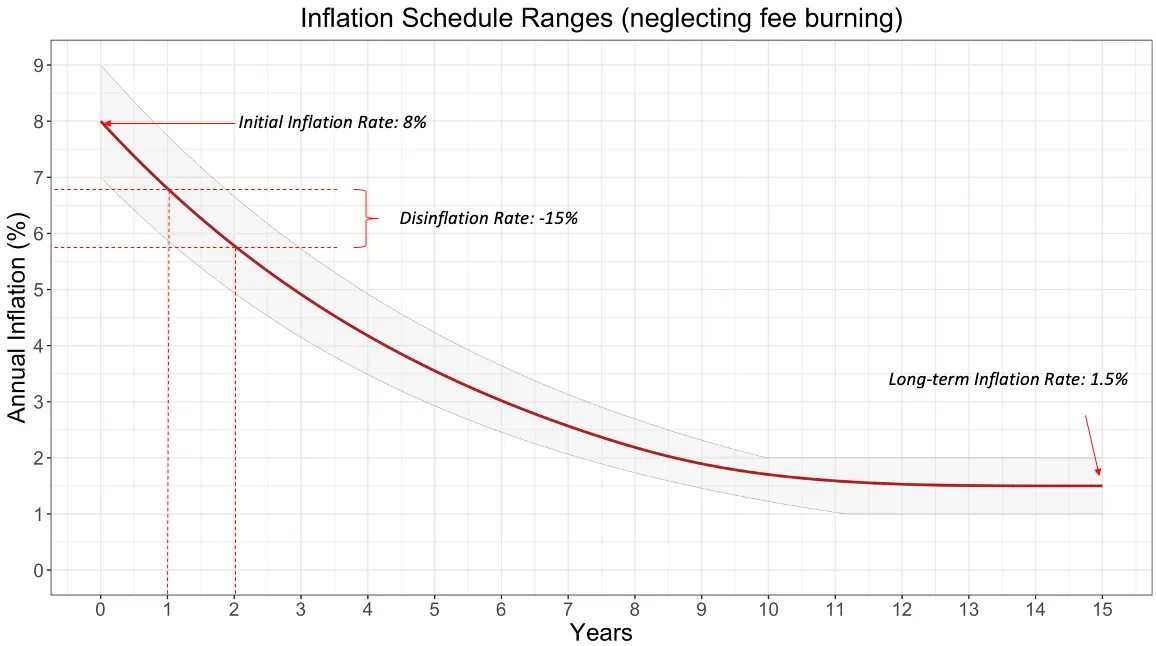
This ratio between issuance rate and burn rate can be calculated to ensure that given a target usage level, ALGO would become deflationary, while also ensuring Validators are compensated above and beyond base transaction fees. Here’s an example of what that could look like for supply overtime given increased usage:
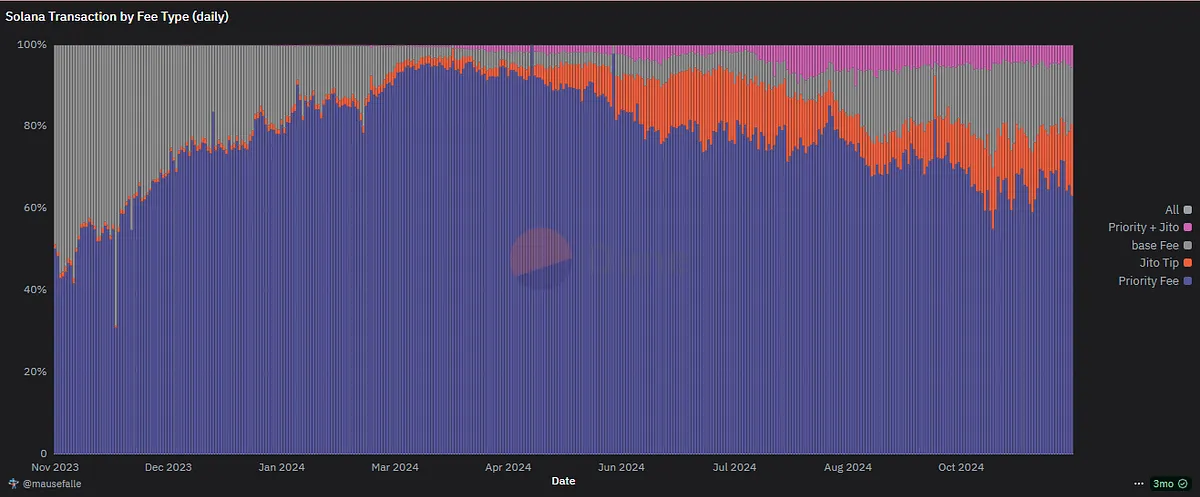
Solana’s fee structure allows price discrimination — high-value users pay more, while low-value users still have access to cheap transactions. This maximizes revenue without deterring participation. Algorand’s one-size-fits-all fee model prevents it from capturing this excess value. Roughly 70% of total Solana txn fees are priority fees, showing a clear demand from the market. It can be argued that the market doesn’t always select for what’s best for humans, but that’s a different debate.
Current State of Algorand
- Average txns per day: ~5.1M
- Total daily txn fees: 5,100 ALGO (~$2,000/day revenue)
- Annual revenue: ~$730,000
- Annual earnings per ALGO staked: $0.000365 per ALGO
- 100k ALGO staked earns: ~$36.50 per year
- Payback period for a Validator (without factoring in costs): 1,068 years
- APR for validators: 0.094%
Just for comparison — Solana’s daily txn fees are averaging $8M/day or 2.92B/yr in revenue.

Protocols must generate revenue above and beyond costs. Otherwise, they rely on token emissions and speculation, and once emissions end (if it’s a capped coin, like ALGO), there’s no income to sustain development or network security.
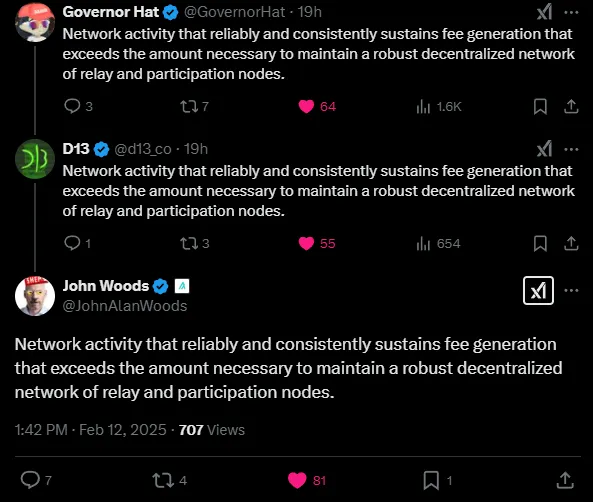
I asked on Twitter ‘In your opinion, what is success for Algorand?’ The most popular reply was:
An important silver lining here — if we get the economics right, I believe we see a mass influx of Solana users. The economic model they have clearly works, but the throughput of Solana in practice struggles. This is where Algorand’s efficient design shines. It’s uncommon for Solana to ever actually reach 2k TPS, never mind the 65k they proclaim. And when they do reach 2k TPS, everything starts becoming extremely expensive. I failed about 10 transactions on the $TRUMP launch, two of which had $20 txn fees, the most I ever paid on Solana for a transaction. This sort of activity reminded me of Ethereum in 2021, where gas prices on contested NFT mints was $1000+. Once txn fees reach these levels, it’s only natural for users to start looking at alternatives. This is our opportunity.
Governance

Proper governance remains one of Algorand’s biggest gaps. There is still no way to propose a general governance vote, only AF can do this. Public goods funding (xGov) hasn’t materially improved over the 1 year alpha period. Governance & public goods funding seems to be consistently deprioritized.
Version 2 of xGov is still being developed — and when it does launch, it won’t be optimal. While slightly better than version 1, it will still have vulnerabilities and suffer from inefficiencies. I understand the need to balance decentralization with efficiency, but for funding decisions, efficiency and effectiveness should take priority. Right now, progress in this area is glacial, and important projects are not being funded. We don’t have the luxury to experiment with xGov for years, it needs to work ASAP.
The lack of urgency around this is frustrating. We should be having weekly calls as a community to iron these details out as they’re complicated. We (the community) talk about what we think is best in dozens of different channels, forum posts, twitter posts, only to have the AF members huddle amongst themselves, do what they want, and then announce what they’re doing with little detail.
The xGov Council
An election for xGov council members is on the horizon. This council will act as a filter, determining which proposals get voted on in general xGov funding rounds. However, its authority is limited — it can only reject proposals that don’t meet the terms of service or the undefined “goals” of the ecosystem.
Once a proposal passes the council, general xGov members vote on it — but here’s where the real problem begins in my view. Voting power is based on the number of blocks proposed, meaning it’s directly tied to your stake, meaning it will be heavily skewed towards whales, protocols, and staking pools.
Why Block Proposals Should NOT Equal Voting Power
This governance model dangerously concentrates control in the hands of the largest holders — particularly DeFi protocols with massive stakes — who could easily pass their own proposals even with quorum restrictions. Large holders do not inherently act in the best interest of smaller participants; they act in their own best interests. This is acutely true for decisions where there’s a pot of money to gain if the decision is made in their favor.
‘Bread and Circuses’ is the cancer of democracy, the fatal disease for which there is no cure. Democracy often works beautifully at first. But once a state extends the franchise to every warm body, be he producer or parasite, that day marks the beginning of the end of the state. For when the plebs discover that they can vote themselves bread and circuses without limit and that the productive members of the body politic cannot stop them, they will do so, until the state bleeds to death, or in its weakened condition the state succumbs to an invader — the barbarians enter Rome. — Robert A. Heinlein
Funding decisions must be neutral, ensuring they don’t disproportionately benefit either large or small holders, but what’s best for the whole ecosystem. While decentralized networks can coordinate effectively on technical protocol upgrades, treasury governance is another matter entirely. If we upgrade the network and it goes down — every ALGO holder is equally negatively effected. We are all aligned. However, if you can extract ALGO from the treasury and pay yourself, this is uniquely benefiting you at the expense of everyone else.
Time and again, we’ve seen that when individuals or entities gain voting power over funding, they almost always direct resources toward themselves rather than prioritizing the long-term sustainability of the network. Personal gain is innate to the human condition, we shouldn’t be naive to this.
The same issue arises in national governance. If citizens could directly vote on government budgets, they would prioritize short-term benefits for themselves over long-term economic health. This is why well-designed governance structures exist — to prevent majoritarian self-interest from eroding long-term sustainability.
Take this hypothetical — but entirely plausible — scenario:
- XYZs LST, xyzALGO, holds 100M ALGO in stake.
- XYZ submits a proposal requesting 100K ALGO to reward their stakers, under the guise of ‘increasing online stake’.
- XYZ has voting power based on the entire staked amount (100M ALGO), and their own treasury.
- XYZ votes in favor of their own proposal, instantly meeting the stake quorum required to pass.
- XYZ users overwhelmingly support the proposal — it’s a direct payment to them — meeting the required accounts quorum.
The proposal passes — entirely within the rules.
In my opinion, the ideal structure would look something like a democratically elected council that independently decides how to allocate funds within a set charter. This ensures both efficiency and accountability, as the council is responsible for all funding decisions and can be voted out or given a new charter if needed — eliminating the need for large-scale, purely self-interested votes on each proposal. Having 100 cooks in the kitchen doesn’t necessarily result in better food.
I believe median-based voting is the best idea to try here. Each council member proposes how to distribute the total budget — say x for Proposal A, y for Proposal B, z for Proposal C — and for each proposal, you take the median of everyone’s votes. Instead of a simple yes/no vote, every member suggests a full budget breakdown. Taking the median for each line item ensures a balanced allocation that reflects the collective input of the council.
Proposals should be submitted with a target funding request. However, the final amount allocated may be higher or lower depending on the council members’ votes and the overall budget constraints. This ensures that funding decisions are not arbitrary but instead represent the relative value of each proposal compared to others under consideration.
To align with the existing governance framework, the council could submit its budget allocations as a proposal, which would then be subject to ratification by the broader community through a supermajority vote. This approach allows the community to make a high-level decision on funding while entrusting the details of proposal evaluation and allocation to the elected council. The community wouldn’t be voting on each proposal, but would be voting on the entire budgeted allocation.
On-Chain Assets vs. RWAs
Algorand’s focus on real-world assets (RWAs) has limited the ecosystem’s growth potential, in my opinion. While this emphasis seemingly positioned Algorand as a serious player for institutions, it has created significant opportunity costs in terms of ecosystem development and network value. I say seemingly because the big institutions like Blackrock are tokenizing their funds mainly on Ethereum, not Algorand! So while we focus on RWAs, RWAs don’t necessarily focus on us. I would also argue that Ethereum and Solana’s growth has been driven by thriving on-chain economies, not RWAs, or anything to do with the ‘real world’ at all.
The things I believe drive most user activity -
- The ability and or opportunity to make money.
- The access to interesting on-chain assets that offer unique opportunities and value propositions.
- The ability to experiment with new models of governance, property rights, economics, AI, and other interesting things.
- The sense of community or comradery that comes with collectively owning something.
This speculation on new assets and protocols is what makes crypto exciting and profitable, not tokenized soybeans or airline tickets (although those are welcome).
The Importance of Ecosystem Neutrality
A blockchain foundation should enable rather than direct ecosystem development. Favoring certain use cases over others creates artificial barriers to innovation and growth, and the direction may be misguided. Every valid use case — whether it’s tokenizing real estate or launching a memecoin — deserves equal consideration and support. Let the market determine how Algorand is best used, not your biases.
Preferential treatment will lead to:
- Discouraged developers in ‘non-preferred’ verticals
- Disproportionate resource allocation
- A less diverse ecosystem
- Stifled innovation / market forces
Algorand’s technology can support both RWAs and dapps effectively. The challenge isn’t technical — it’s cultural. Simply recognizing that both traditional and crypto-native applications create value, and will be supported equally on Algorand, would be sufficient for me.
The future isn’t real world, serious, institutional vs. on-chain, degen, cypherpunk— it’s anything and everything. By embracing this and maintaining strict neutrality, Algorand can open itself up to more on-chain activity. Algorand can do a lot more than it’s being credited for when simply promoting RWAs (or any other narrow vertical).
The Road Ahead

The vibes have improved massively over the past year — on the timeline, in conversations, and even on the chart. However, we’re still in the middle of the pack, and most of our gains are due to a broader crypto rally.
The biggest tailwind for Algorand — and crypto as a whole — is the shifting regulatory landscape in the U.S. Clear, well-defined rules would unlock massive growth, and Algorand stands to be a major beneficiary. The real obstacle for mainstream adoption hasn’t been technical limitations but regulatory uncertainty, which has kept major players — from banks to tech giants — on the sidelines. Many development teams, including TxnLab, have shelved promising ideas out of fear of arbitrary SEC enforcement. With regulatory clarity, those projects that never got off the ground will finally have the green light to move forward.
The Algorand Foundation can’t afford to sit on the sidelines — it’s time to play the game. That means showing up at key events, building relationships with decision-makers, and making sure Algorand has a seat at the table in policy discussions.
This administration may only last four years, but the right moves now could cement legislation that protects crypto in the U.S. long-term. Algorand doesn’t need to grovel like Ripple — it just needs to be in the room, promoting great tech, and strong core values.
Closing Thoughts

At the end of the day, the pieces are in place. Algorand has world-class tech, a stronger team, and an improving macro environment. But none of that guarantees success. Execution is everything. Governance needs real fixes, the economic model needs refinement, and we need to embrace the full spectrum of what crypto is — not just what feels safe or institutionally palatable.
Now is the time, now is the best time
Now is the best time of your life
-Robert B. Sherman
Images generated with ChatGPT
Edited by ChatGPT 4o, o1, Claude 3.5 Sonnet, Gemini 2.0 Flash, and my brain
This piece originally appeared on Medium .