Misalignment of Spending
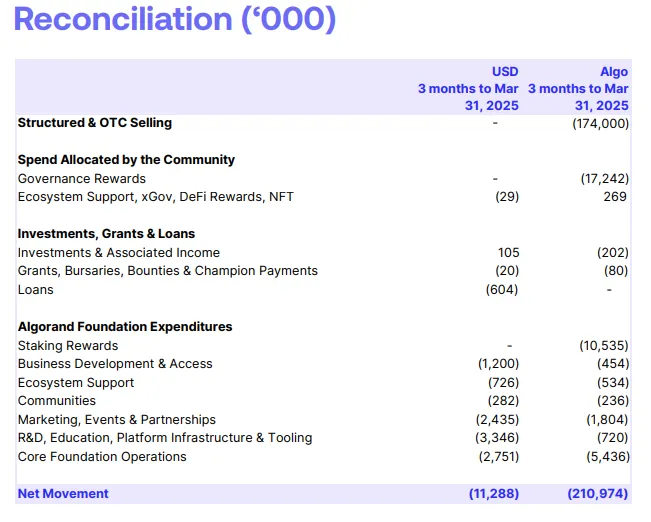
Total net outflows for Q1 2025: $72.5M (rounded, assumes $0.29 avg sale price)
174M ALGO was sold directly on the market through structured selling. At an average price of $0.29, that nets approximately $50.5M USD.
The scale of this selling dwarfs every other line item in the Foundation’s expenditures. For comparison, staking rewards — arguably the most important category for long-term network health — accounted for just ~5% of total ALGO outflows.
So what did we get for the other 95%?
- $85k in ecosystem investments
- $745k in ecosystem loans
- $245k to Pera, which the Foundation owns
- $500k deployed as liquidity on Lofty, not a direct loan
- 10.5M ALGO in staking rewards
- 17.2M ALGO in governance rewards (which the community didn’t even ask for)
If you count all of that as “community support,” it totals roughly 30M ALGO out of 211M — or ~14% of total ALGO spend.
That’s the number to focus on. 14% of ALGO outflows arguably helped the community. The other 86%? Mostly structured sales.
Putting 10M ALGO toward staking while dumping 174M ALGO into the open market is not just self-defeating — it’s actively harmful. It suppresses the token price — the primary metric that developers, investors, and new users alike look at when evaluating a network’s health.
More importantly, it reveals a fundamental misalignment between the community and the Foundation.
Structured selling at this scale sends a clear message: the Foundation doesn’t believe in the long-term potential of ALGO. It values liquidity today more than price appreciation tomorrow.
If that’s not the intent, then what is the strategy?
What is the USD being accumulated for?
Why has selling ramped up?
Why isn’t most of it coming back into the ecosystem in the form of investments / support?
Story Time
TxnLab worked on Réti Pooling for over a year. We had a contract with the AF to build the protocol for $120k over three months (Jan–Mar 2024). We delivered on time and in full.
Then we kept building — over a year more, unpaid. We polished the protocol, added features, answered support tickets, and ensured it launched smoothly. Réti has no protocol fee. It’s a public good.
We should’ve asked for maintenance in the original contract, but assumed a public goods funding mechanism (like xGov) would exist by now. It doesn’t.
So we made a modest request: just $2–3k/month to keep supporting Réti — the second largest staking protocol on Algorand, holding 13.3% of all online stake.
The response, after more than a month of waiting, was: no.
I’m not telling this story for sympathy, but to illustrate that the ecosystems priorities are out of whack. Réti is a meaningful piece of infrastructure. Supporting it should be obvious. But right now, it isn’t.
Structural Change
So what can we actually do?
In public companies, shareholders elect the board. The board selects execs. If those execs perform poorly, shareholders replace the board. This creates a tight feedback loop between performance and accountability.
That doesn’t exist here.
ALGO holders are directly impacted by the Foundation’s decisions, yet have no ability to change leadership or strategy. There’s no feedback loop. And that’s dangerous.
We need a governance structure more aligned with token holders — even if that just means a non-binding on-chain board election. The Foundation could set it up. Even if it doesn’t grant control, it would allow the Foundation to temp check the community.
More Mild Change
- Cut headcount. Run like a lean startup, not a bloated SaaS. Cut middle management who don’t produce anything.
- Focus spending on builders. Engineers, DevRel, and the teams who are shipping and growing the ecosystem.
- Stake most of the remaining ALGO. Halt structured selling.
- Live off staking rewards — just like the rest of us.
The AF could stake ~1B ALGO, and then use the remaining ~400M to extend incentivized consensus rewards + sell to cover expenditures.
Roughly speaking, if you could maintain even a 5% yield on 1B ALGO staked, that would be 50M ALGO per year in rewards (not including organic txn fees) which you could sell to fund operations.
We should assume that all of these sales have resulted in the AF having a substantial USD balance, not reflected in the transparency report. This means going to a strategy like this (reduce sales, live off rewards) isn’t unrealistic. They could sell ~100M ALGO per year (50M from rewards, 50M remaining ALGO), and rely on their cash in the bank to cover the rest.
A 9–5 mentality doesn’t cut it in crypto. This space moves too fast and is too competitive. You can’t just clock in — you need to be living and breathing Algorand every day. That level of focus and urgency is what it takes to build something that actually matters.
It wouldn’t be painless. Rewards would drop. The Foundation would shrink.
But the tradeoff?
No more structured selling.
A leaner, hungrier, and better-aligned Foundation.
Moving Forward
I’m hosting a Twitter Space [5/1] to talk through all of this. Please come and share your thoughts.
@AlgoFoundation, board members, execs: I invite you to join!
If you can’t attend, DM me any thoughts — I’ll read them on the space and publish them in this blog for everyone to read. I would like this to be an open and constructive conversation.
Update 5/2:
Recording of space: https://www.youtube.com/live/lpNaF6ziZsA?si=BC7CUtUvVWl3UvMH
This piece originally appeared on Medium .