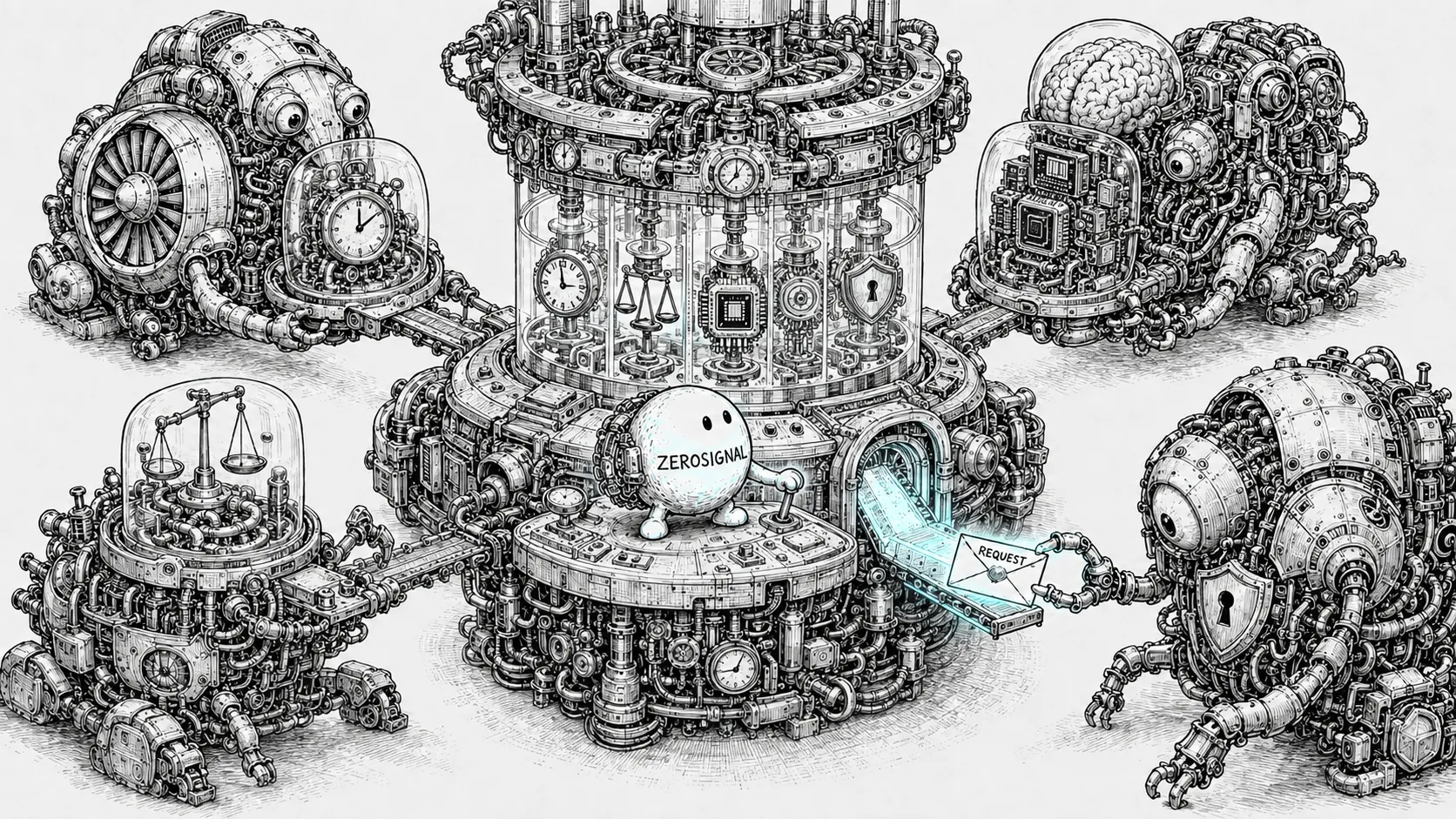
Why We're Building ZeroSignal
The most revealing thing you type today may be something you never intend to publish.
You might ask an AI to review proprietary code, interpret a medical result, stress-test a business idea, rewrite a difficult message, or tell you whether you are being unreasonable in an argument. The value comes from showing the model what is unresolved. You give it the draft, the doubt, the mistake, and the question you would prefer to ask without an audience.
Search engines learned what we were curious about. Social networks learned what we wanted other people to see. AI assistants can learn how we think before we decide what to say.
That makes an AI conversation unusually intimate. It also creates a privacy problem at exactly the moment we’re rushing to place these systems inside every part of our lives.
I’m part of the three-person TxnLab team building ZeroSignal, so discount the argument accordingly. We obviously want the product to succeed. I also believe private access to AI will become a basic piece of digital infrastructure, and that the important architectural choices are being made now.
The demand for privacy is mostly hidden
People say they value privacy and then choose the more convenient product. Economists might call this revealed preference and move on.
That conclusion is too easy. Private alternatives are often slower, weaker, more expensive, or difficult to use. The observed choice bundles privacy together with ten other product qualities. Most users are choosing the better product, not expressing a considered preference for having their private data collected.
Privacy therefore has to compete on convenience. A system that asks every user to study cryptography, manage a server, or accept a much weaker model will remain a niche product for people already convinced of the cause.
The market is moving quickly. In 2026, Pew found that 49 percent of American adults use AI chatbots and 24 percent use them daily. Among employed adults, 38 percent use them for work. Twenty percent have used them for medical advice, and one in ten has used them for emotional support or advice.
The categories are more important than the topline number. Work, health, relationships, fears, and unfinished ideas now enter the same interface. A sufficiently long AI history may reveal more about a person than an inbox because it contains the material that never became an email.
Companies see the problem. Cisco’s 2026 privacy survey found that 90 percent of organizations expanded their privacy programs because of AI. Only 12 percent described their AI governance committees as mature and proactive. Adoption is outrunning governance, which is the normal state of affairs for an important new technology.
The economics of memory favor memory
AI products become more useful when they remember. History improves personalization. Logs help with debugging, abuse prevention, compliance, billing, and product development. Stored context makes the assistant feel continuous. It can also increase switching costs, whether or not that’s the original intention.
Inside a normal technology company, almost every constituency can offer a reasonable argument for keeping more data. Very few people are rewarded for proving that a piece of data should never have been collected.
This doesn’t require a malicious company. The likely outcome comes from ordinary incentives. Data accumulates because each individual decision to retain it is defensible.
The major AI providers deserve credit for improving their policies. OpenAI says it doesn’t train on business or API data by default and offers retention controls to qualifying customers. Anthropic makes a similar commitment for its commercial products. Consumer products increasingly offer temporary chats, training opt-outs, incognito modes, and deletion controls.
These policies are meaningful. I use many of these products, and I don’t assume the companies behind them are waiting for an opportunity to misuse my data.
The structural question remains. One organization can still possess the account identity, IP address, payment information, usage patterns, conversation history, and prompts. A privacy policy limits how that database is used today. Possession creates options for tomorrow.
Terms change. Companies are acquired. Employees make mistakes. Databases are breached. Courts and governments compel records. Concentrated information creates a concentrated point of pressure even when the original collector behaves responsibly.
Architecture can reduce the number of future decisions that anyone gets to make.
That’s the privacy principle behind ZeroSignal: avoid giving any participant the whole picture.
What is ZeroSignal?
ZeroSignal is a privacy-preserving, decentralized market for AI inference. Inference is simply the act of running a trained model to produce an answer. ZeroSignal creates a market between users who need that computation and independent operators with hardware available to provide it.
Operators publish the models they can serve, their prices, and their capabilities. A proxy on the user’s own machine compares the available offers and selects an operator for each request. Every prompt creates a small contest among suppliers. May the best operator win.
Most people will meet ZeroSignal through the chat app at zerosignal.ai. It looks like the AI chat window you already use. Open the site, create an account with a passkey, pick a model, and start typing. There’s no email to confirm, no password to invent, and no card to enter before the first question. Free models are there to start with. Your conversations stay encrypted on your own device instead of in an account on our server, and a balance sits in the corner that you draw down one request at a time.
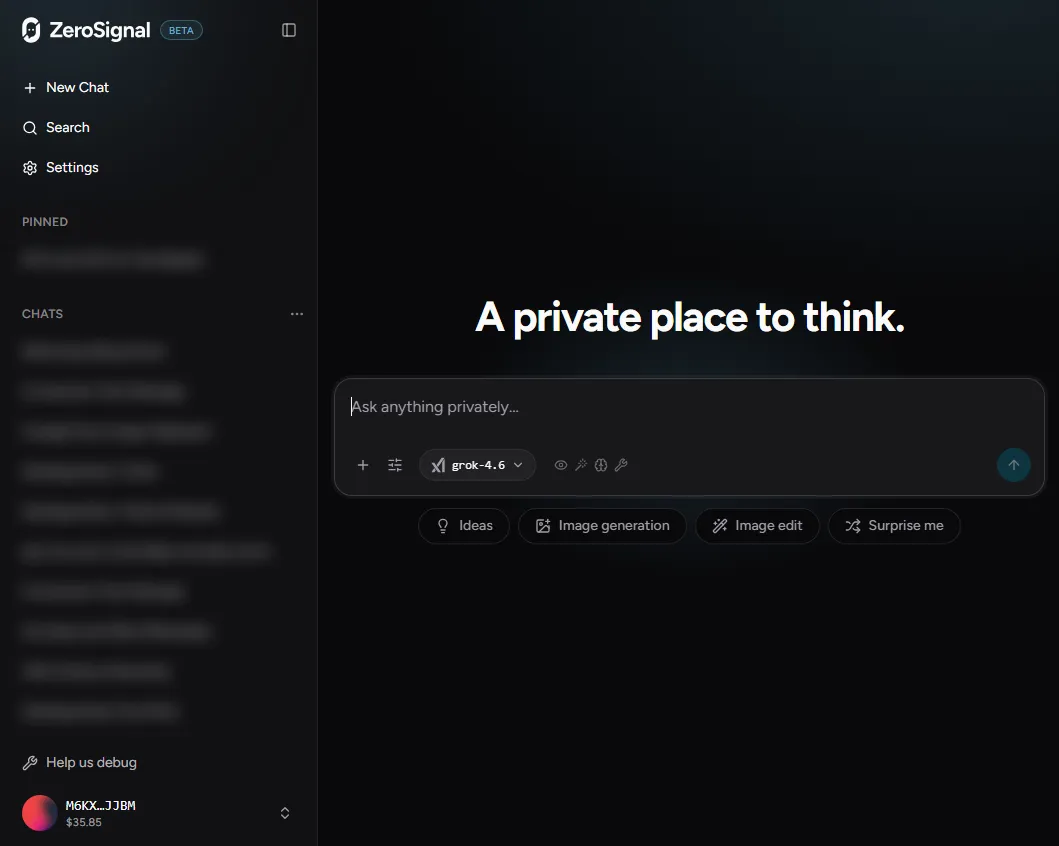
Existing software gets its own entry point. To a coding agent, an OpenAI SDK, or another compatible tool, the proxy looks like a normal OpenAI-compatible API running on localhost. The tool sends a request as usual. The proxy encrypts it, routes it through the network, handles payment, decrypts the response, and returns it to the tool.
The user gets a familiar interface. The architecture underneath is very different.
Splitting the information bundle
A conventional AI provider usually sees the entire transaction. ZeroSignal separates it into parts.
The relay sees the user’s IP address and forwards encrypted traffic. It can’t read the prompt. The operator performs inference on the prompt, but the relay prevents it from receiving the user’s IP address. The settlement layer sees an address and a payment, but no prompt or real-world identity. The full context comes together only inside the user’s local client.
The proxy chooses the relay and operator independently. Users can also change operators from one request to the next. A single inference provider doesn’t need to accumulate a long-term history of the relationship.
The browser follows the same logic. A passkey creates a self-custodial account. ZeroSignal doesn’t require an email address, password, KYC form, or payment card tied to the chat account. Conversation history stays local rather than accumulating in a central server-side archive. The local proxy’s operational logs exclude prompts and responses.
There’s no obvious database inside ZeroSignal that can answer both “who is this person?” and “what have they been thinking about?” This is the feature I care about most.
Competition is also a privacy feature
Privacy promises are more credible when the customer can leave.
ZeroSignal uses a public on-chain registry of operators. Suppliers announce what they can serve and at what price. The user’s local proxy filters those offers according to price, performance, model capability, and privacy preferences, then awards the request.
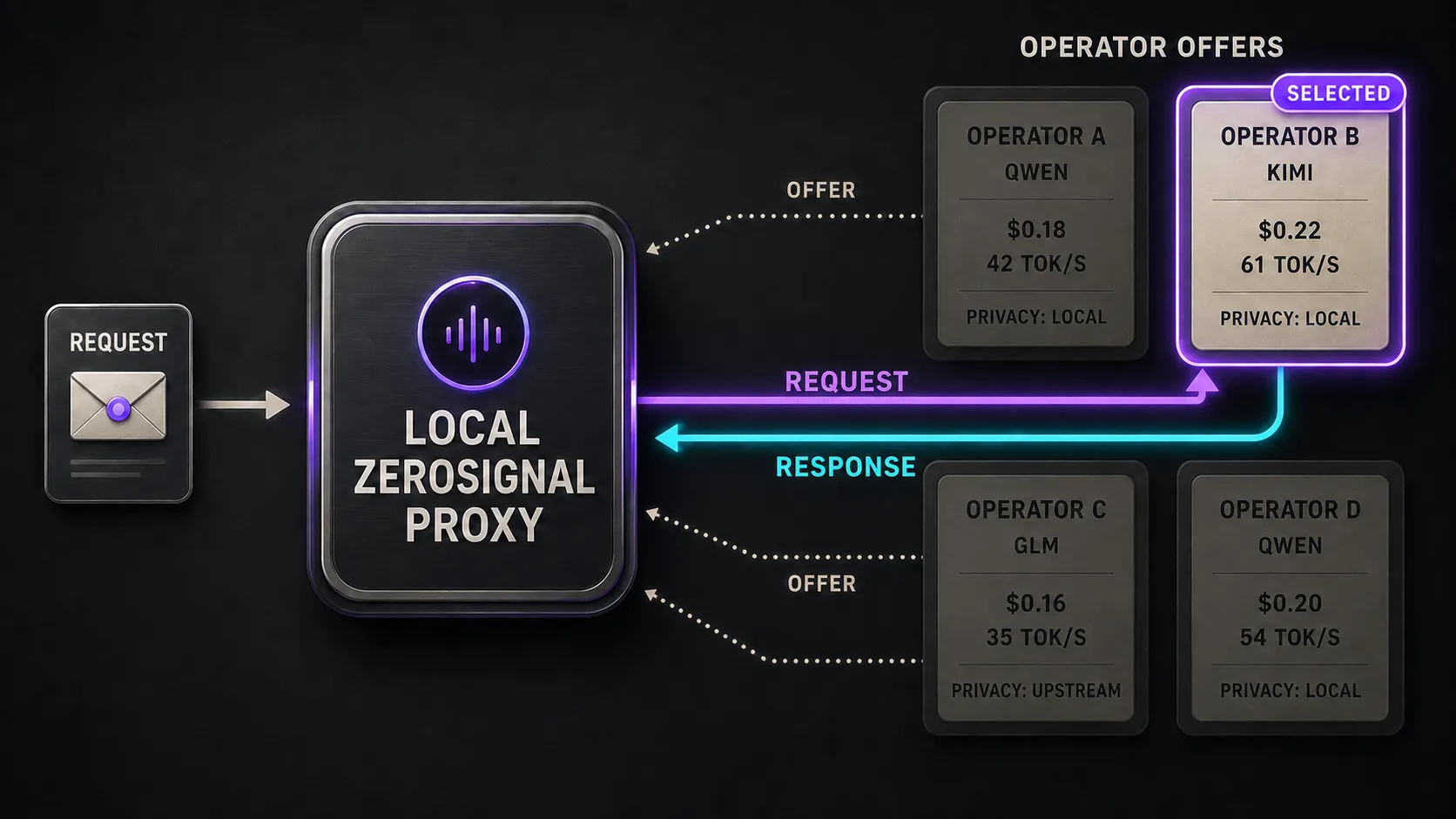
An operator can add hardware, offer a different model, specialize in a region, or invest in stronger privacy guarantees. Anyone meeting the public staking and registry rules can participate without negotiating a platform agreement.
This creates a useful feedback loop. Better privacy can become something operators compete to provide instead of a policy written by the only available supplier. A user who distrusts an operator can exclude it. A weak operator loses future requests. Exit gives the preference some force.
Payment settles per request in USDC on Algorand from a self-custodial account. A signed receipt records what the selected operator charged and delivered. TxnLab doesn’t hold a prepaid customer balance, approve each operator by hand, or route each request on a central server.
The blockchain has a narrow job: publish the market and settle transactions without a custodial intermediary. Prompts, chat histories, and real-world identities stay off-chain.
This is why the distinctive feature of ZeroSignal is the combination rather than any single technology:
- No-email, passkey-based access.
- Local, encrypted conversation history.
- An OpenAI-compatible local proxy for existing tools.
- Separation between the relay that sees the connection and the operator that sees the request.
- Client-side selection among competing inference operators.
- A permissionless registry of models, prices, and capabilities.
- Self-custodial, per-request settlement.
Each feature removes one reason a central intermediary would need to know more about the user.
Decentralization has to earn its place
The word decentralized has survived an impressive amount of abuse. A blockchain entry doesn’t make a system neutral. A marketplace can list hundreds of suppliers while one company still controls admission, ranking, routing, custody, and settlement.
For ZeroSignal, decentralization is useful only where it removes a real control point.
Operator discovery is public, so a central service doesn’t decide which offers exist. Routing happens locally, so ZeroSignal doesn’t award every request. Funds remain self-custodial, so an account administrator doesn’t hold the user’s balance. Operators set their own prices and policies, so one operator’s refusal doesn’t become a network-wide refusal.
This connects privacy with access. A provider that can associate identity, location, payment, and prompt history also has more ability to profile, throttle, or exclude. Separating those facts protects secrecy and preserves the ability to move.
I wrote more about the access side in Who Gets to Use Intelligence?. Privacy and exit are complements. Both improve when suppliers are replaceable and no intermediary holds the entire relationship.
What ZeroSignal protects today
Privacy claims deserve annoying precision.
ZeroSignal currently provides strong anonymity and data minimization. The operator doesn’t receive the user’s IP address, and the relay can’t read the request. ZeroSignal doesn’t require an email, card, or conventional account, and it doesn’t maintain a central server-side chat history.
The selected operator can still read the plaintext prompt while its hardware performs inference. An operator that forwards a request to a proprietary upstream provider also brings that provider’s practices into the trust model. Encryption protects the request in transit. Ordinary inference still requires decryption somewhere.
Our path toward stronger protection uses trusted execution environments and remote attestation. The goal is for the local client to verify the software and confidential hardware serving a request before releasing the prompt. Properly implemented, an operator could supply compute without gaining access to the content being processed.
That work is unfinished. Early operator supply is limited. The software, registry, settlement contracts, relay design, and economics all need to survive real use and adversarial pressure. Privacy isn’t magic, and decentralization doesn’t abolish trust.
The present system reduces how much trust any one participant receives. The longer-term goal is to make the remaining trust narrow, visible, replaceable, and verifiable.
Why build this now?
Privacy is often treated as a setting to add after the product works. AI privacy reaches deep into account design, routing, payments, storage, memory, and the relationship between the user and the model provider. Retrofitting those choices later will be expensive.
The incentives also grow stronger with time. Assistants are becoming coding partners, researchers, tutors, financial tools, health interfaces, and agents acting across other software. Each new integration adds value. It also adds context. The provider increasingly sees the user’s work and life as a connected whole.
Local inference offers the strongest control when it fits the task. It will continue to improve. Many users will still want models or speeds that require remote hardware. If privacy requires accepting a large capability penalty or buying a rack of GPUs, it will remain a luxury good.
There should be a middle path: cloud-scale AI inference without a central service tying every prompt to an identity. ZeroSignal is our attempt to build it.
Most users will never care that operator offers live in an on-chain registry or that payment settles through signed receipts. That’s fine. Good infrastructure becomes boring at the surface. A person should be able to open a private chat or point an existing tool at localhost and get a useful answer.
The most plausible privacy failure looks ordinary: default settings, permanent histories, helpful integrations, and reasonable decisions to retain one more category of data. Each choice improves the product. Together they can turn private thought into a permanent corporate record.
We’re still early enough to build systems that forget on purpose.
A society that increasingly thinks through machines will need some machines that don’t remember who was thinking.